Kantorek
Kantorek is the schoolmaster who, through patriotic rhetoric, persuaded Paul Bäumer's entire class to volunteer for World War I, embodying the authority figures whose ideals are shattered by the reality of the trenches. His later humiliation as an inept territorial soldier under the command of a former student represents a stark reversal of power and a symbolic reckoning with the generation that sent young men to die.
Identity and Background
Kantorek was a stern little man in a grey tailcoat, with a face like a shrew mouse, who taught at the school attended by Paul Bäumer, Albert Kropp, Müller, Leer, and their classmates. He was about the same size as Corporal Himmelstoss, the notorious drill-sergeant, a coincidence that leads Paul to reflect that the unhappiness of the world is often brought on by small men, who are so much more energetic and uncompromising than the big fellows. During drill-time, Kantorek gave long lectures until the whole class went, under his shepherding, to the District Commandant and volunteered. Paul recalls him glaring through his spectacles and saying in a moving voice: "Won't you join up, Comrades?" These teachers always carried their feelings ready in their waistcoat pockets and trotted them out by the hour. One student, Joseph Behm, a plump, homely fellow, hesitated and did not want to fall into line, but he allowed himself to be persuaded, otherwise he would have been ostracised. Kantorek and others like him were convinced they were acting for the best—in a way that cost them nothing.
Role as an Authority Figure and Its Collapse
For the lads of eighteen, Kantorek and his fellow teachers ought to have been mediators and guides to the world of maturity, work, duty, culture, and progress—to the future. The idea of authority they represented was associated in the students' minds with a greater insight and a more humane wisdom. But the first death they saw shattered this belief. Paul's generation had to recognise that their own was more to be trusted than theirs. The teachers surpassed them only in phrases and in cleverness. The first bombardment showed the students their mistake, and under it the world as the teachers had taught it broke in pieces. While the teachers continued to write and talk, the soldiers saw the wounded and dying. While they taught that duty to one's country is the greatest thing, the soldiers already knew that death-throes are stronger. The soldiers learned that what matters is not the mind but the boot brush, not intelligence but the system, not freedom but drill. The classical conception of the Fatherland held by their teachers resolved itself into a renunciation of personality—salutes, springing to attention, parade-marches, insults, and a thousand pettifogging details. The soldiers had fancied their task would be different, only to find they were to be trained for heroism as though they were circus-ponies.
Reversal of Power and Humiliation
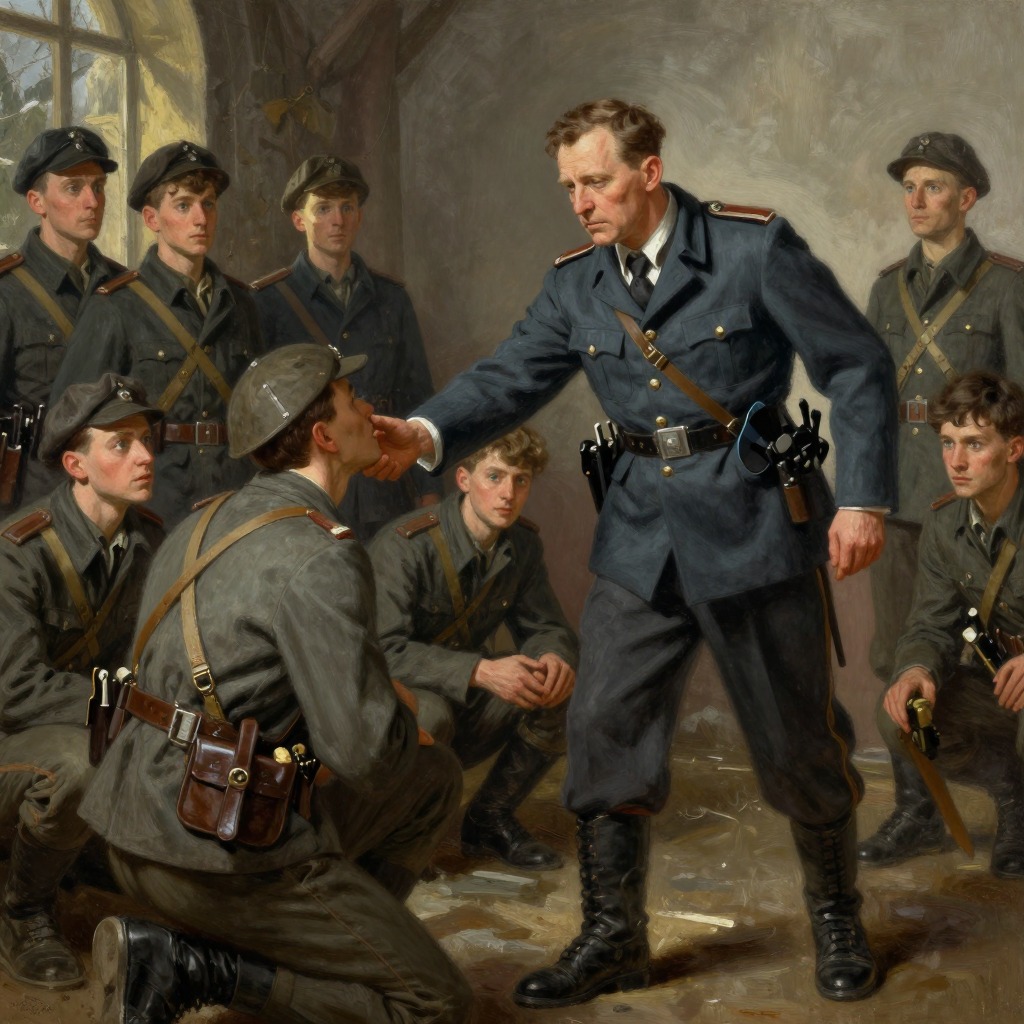
During Paul's leave, he visits his friend Mittelstaedt, who has news that electrifies him: Kantorek has been called up as a territorial. Mittelstaedt, now a non-commissioned officer, has been put in charge of Kantorek's company. When Kantorek stretches out his hand and bleats a greeting, Mittelstaedt snubs him, reminding him of Joseph Behm, who was killed three months before he would have been called up in the ordinary way because Kantorek preached them into enlisting. Mittelstaedt then fits Kantorek out with a ludicrous uniform: a faded blue tunic that must have belonged to a giant, with big dark patches on the back and sleeves; black, worn breeches reaching barely halfway down his calf; tough old clod-hoppers much too big for him; and a terribly dirty, mean little pill-box of a cap. Mittelstaedt stops in front of him and says, "Territorial Kantorek, do you call those buttons polished? You seem as though you can never learn. Inadequate, Kantorek, quite inadequate—"—the very expression Kantorek used to chastise Mittelstaedt at school. Mittelstaedt makes Kantorek practise skirmishing, appointing him squad leader, a role that forces him to dash backwards and forwards forty paces at every about-turn, exactly as Himmelstoss used to torment recruits. Kantorek is also made to creep on hands and knees over the sand, breathing hard, while Mittelstaedt quotes Kantorek's own schoolmasterly phrases back at him: "Territorial Kantorek, we have the good fortune to live in a great age, we must brace ourselves and triumph over hardship." The extra fatigues include bread fatigue with the school porter Boettcher, pushing a handcart through the whole length of the town, a spectacle that has become a regular entertainment for the locals.
Thematic Significance
Kantorek represents the entire generation of authority figures—teachers, parents, and propagandists—who, from a safe distance, sent young men to war with noble phrases while understanding nothing of its reality. His transformation from the menacing figure at the schoolmaster's desk, who could make students stand in anguish as he speared at them with his pencil for mistakes in irregular French verbs, into a pitiful, incompetent soldier in a ridiculous uniform, breaks the spell of authority. Paul reflects that he cannot reconcile this skinful of woe with the man who once demanded the imperfect of "aller." The reversal is complete: the school porter Boettcher is now held up as a model for Kantorek to learn from. Mittelstaedt's treatment of Kantorek is not merely personal revenge but a symbolic act of the front-line soldier against the home-front rhetorician. As Paul notes, a man might well die easier after the army has given him just one such stroke of luck. Kantorek's fall from the pedestal of authority to the absurdity of the territorial uniform exposes the hollowness of the patriotic education that sent a generation to its death.